
Key Facts and Statistics
Brain cancer is one of the most complex and challenging cancers. While it affects fewer people than many other cancers, its impact is profound – it disproportionately affects children and young adults, survival rates remain low, and progress has been slow compared to other cancer types. Understanding the numbers helps highlight the urgent need for more research, better care, and stronger support for those affected.
This section shares key statistics about brain cancer in Australia, including who it affects, outcomes, and trends over time. The data provide important context for advocacy, funding, and policy – and helps make visible a disease that too often goes unseen.
Low survival outcomes and a devastating disease burden
Although brain cancer is classified as a less common cancer based on incidence, it imposes one of the highest total burdens of any cancer.
Brain cancer kills more Australians under 40 years of age than any other cancer and is the leading cause of cancer-related deaths in children and young adults, causing among the highest years of life lost per diagnosis. By 2050, more than 23,000 Australians are expected to be living with brain cancer, with approximately 2,650 deaths annually.
By 2050

Source: “Biointelect analysis,” 2025
Despite its severity, five-year survival rates have remained largely unchanged over the past three decades, improving only marginally from 19% to 23% between 1990-1994 and 2015-2019. This stagnation highlights the urgent need for renewed investment and strategic focus.

Source: Australian Institute of Health and Welfare
An outsized economic and social impact
The economic and social costs to patients, families, carers, the health system and society far exceed those of more common cancers.
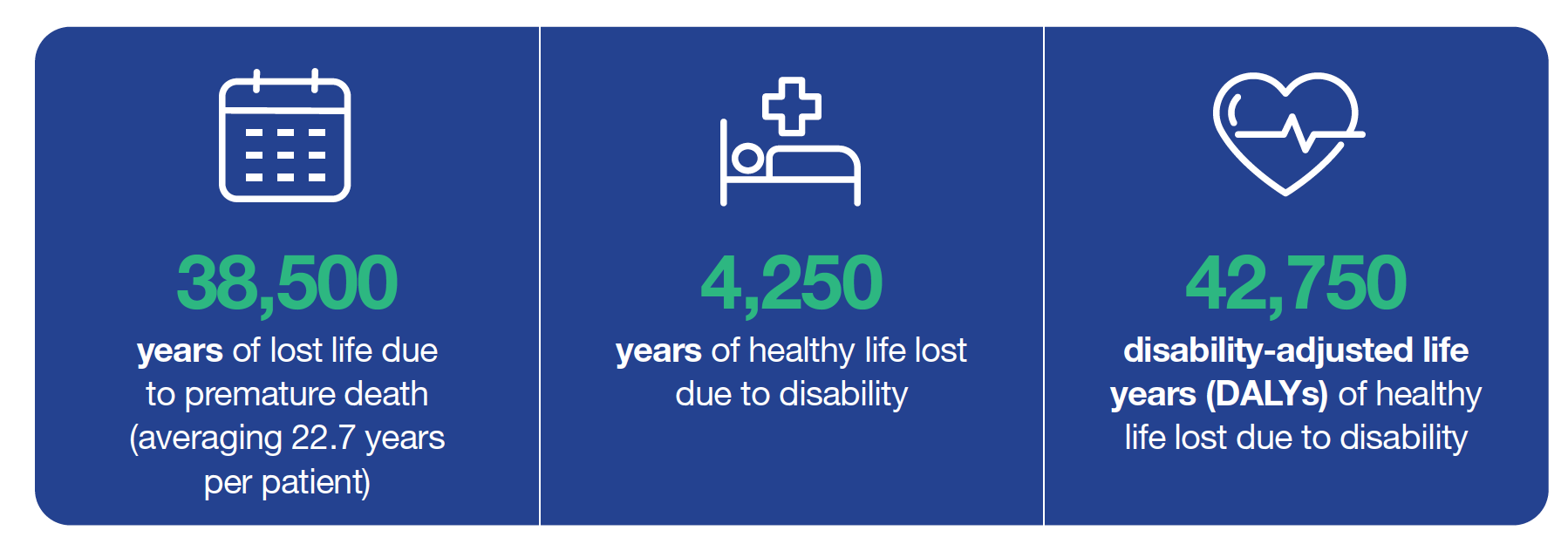
In 2025 alone, brain cancers are projected to result in 38,536 years of life lost due to premature death, with an additional 4,249 years lost to disability, totalling 42,794 disability-adjusted life years (DALYs).
In 2025 alone, brain cancers are projected to result in:
Source: “Biointelect analysis,” 2025
The predicted loss of productivity due to diagnosis is estimated at $251.3 million, with a further $153.1 million lost due to caregiving responsibilities. Informal care is estimated to require 3.7 million hours in 2025 in Australia. Biointelect analysis estimates the total societal cost at $0.85 billion in 2025, rising to $3.2 billion by 2050 if current trends continue.

Source: Australian Institute of Health and Welfare
Healthcare-related costs are similarly significant, with estimated national expenditure of $313 million in 2025, equating to $29,963 per affected individual. These figures reflect the high treatment burden and systemic inefficiencies that contribute to late-stage diagnoses and ongoing financial strain on Commonwealth, State, and Territory health budgets.

Source: Australian Institute of Health and Welfare
Funding disparities and survivorship costs
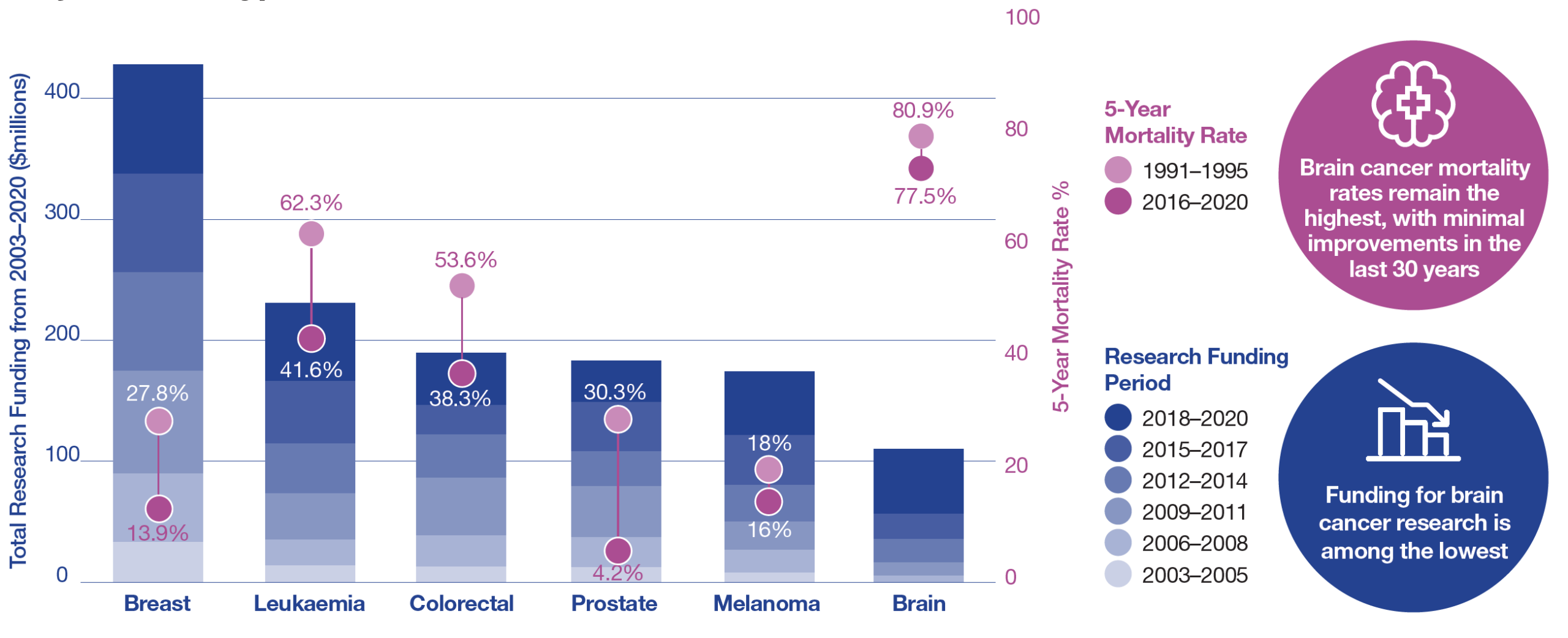
Considering the profound burdens from both the disease and its treatment and the number of deaths each year relative to incidence, brain cancer receives disproportionately low funding compared to other cancers.
Between 2003 and 2020, brain cancer research received only $111.6 million in government funding, far below breast cancer ($431.6 million), leukaemia ($234.7 million), colorectal cancer ($190.8 million), prostate cancer ($184.7 million), and melanoma ($175.5 million).
This disparity is further highlighted by survivorship studies showing that individuals with brain cancer incur the second highest mean annual healthcare expenditure per person at $30,264, almost double the average across all cancers at $15,889.
Source: Cancer Australia (2023), Cancer Research in Australia: An overview of funding for cancer research projects and programs in Australia
The urgent need to confront the burden of brain cancer
Brain cancer remains one of the most devastating cancers in Australia.
Brain cancer is among the most complex and devastating diseases across all age groups, with over 100 distinct tumour types classified by the World Health Organization (WHO) [3]. These tumours vary significantly in their biological behaviour, treatment responsiveness, and prognosis, necessitating highly individualised care strategies [4].
In Australia, brain cancer remains one of the most devastating cancers, with around 1,924 Australians diagnosed and 1,579 lives lost in 2023 alone [5]. Despite advances across many other cancers, five-year survival for brain cancer is only about 23%, one of the lowest of all major cancers [6]. The burden extends far beyond the patient, with families often facing sudden and intensive caregiving responsibilities, significant financial strain from out-of-pocket costs, and loss of workforce participation [7]. For regional and remote patients, the need to travel for specialist care compounds inequities [8]. The economic impact is considerable, combining high hospital and treatment costs with lost productivity and the unmeasured toll on carers. Targeted investment through initiatives such as the ABCM is critical to improving survival, quality of life, and reducing the disproportionate social and economic burden borne by Australian households [9].

Source: Australian Institute of Health and Welfare